Told from Above · a Shramko 360 series
 Author: Andrii Shramko
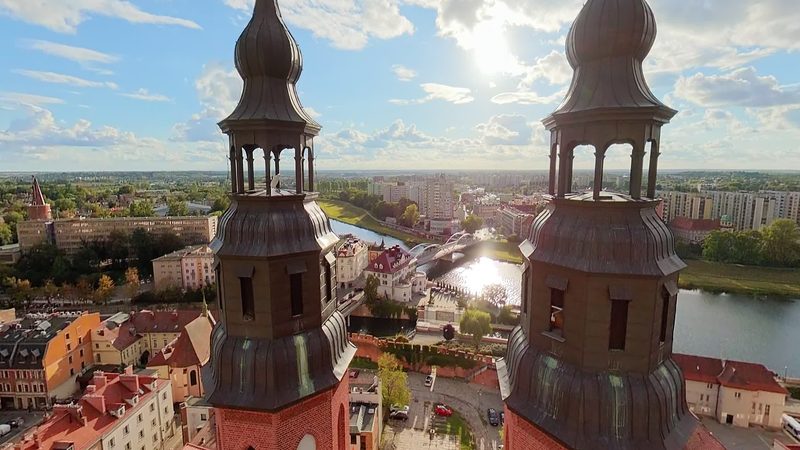
Cathedral and St Sebastian's Church, Opole — a guided 360° flight
- 6 min
- 360° · 8K
- Open captions
- Online since 21 October 2026
In 1997 the army blew up the embankments and flooded the whole of Zaodrze to save Opole's Old Town.
About the film
The water rose so fast that residents waited for hours to be rescued on the roofs and balconies of tower blocks. In this film I fly over Opole, from the cathedral and St Sebastian's Church to St Alexius' Chapel, the Piast Bridge and the Holy Trinity Church.
The guide tells, among other things, about Ryksa the lioness, who during the Millennium Flood kept her head all day in a narrow gap between the water and the ceiling of her cage, and why St Sebastian's was called the "little Polish church". One more story from the film: when the ball came down from the cathedral's southern tower in 2009, a tube lay inside with postcards of old Opole, coins and a catalogue of the town's Reichstag deputies.
If you are ever in Opole, take a close look at the cathedral's bronze doors: Adolf Panitz designed them, and their scenes tell the history of the town and the church.
Places in the film
- Opole Cathedral Map
- St Sebastian's Church Map
- St Alexius' Chapel Map
- Piast Bridge (Most Piastowski) Map
- Holy Trinity Church Map
- Zaodrze Map
The guide's full text (English)
When the ball came down from the southern tower of Opole Cathedral in the year 2009, a tube lay inside with postcards of old Opole, coins and a catalogue of the town's Reichstag deputies. Twin brick towers rise beside us.
In German times, only St Sebastian Church held its services in Polish, which is how it got the name Polnisches Kirchlein, the little Polish church. Its small white gable faces us.
Duke Bolko ringed Opole's Old Town with walls, and their Barbara tower was later turned into a prison for clerics; in the year 1822 part of its bricks went into rebuilding Opole's town hall.
Adolf Panitz designed the bronze main doors between the twin towers, set in place for an anniversary of the death of St Wojciech, and their scenes tell the story of the town and its church.
On the anniversary of martial law, a statue of the priest Jerzy Popiełuszko was unveiled in front of Opole Cathedral; the Opole Solidarność region paid for it, and a casket inside holds relics from his robes.
Bishop Franciszek Jop searched in vain for the bells stolen in the war, so a new set was bought; only the smallest survives from the old one, and the biggest, Urban, ranks among the region's largest.
The Odertor, an old gate in the town walls, stood by the hospital of St Alexius Chapel until it was pulled down in the year 1889. A small green turret tops the chapel.
In June of the year 2007, lights were switched on along the so-called Opole Venice: the stretch of the Młynówka that runs from the Cathedral Bridge to the Zamkowy Bridge.
The Germans blew up the crossing to Bolko Island; for many years only ferries carried people over, until the year 1960 brought the footbridge on Spacerowa Street, which still stands.
The Zaodrzański Bridge on Spychalskiego Street replaced a dyke across the Ulgi Canal that was meant to be temporary yet stayed despite the flood danger; until it went, traffic could only head towards the centre, MZK buses included.
In the Middle Ages a trade road from Kraków to Wrocław met the Odra where the Piastowski Bridge stands. In the year 1886 the Jahrhundertbrücke rose on this spot: the Century Bridge of old postcards.
Neighbouring countries suffered too when the Flood of the Millennium struck Poland in the year 1997; in Opole the water reached part of the town, even a slice of the centre, and the islands of Bolko and Pasieka.
Under water went the Toropol ice rink with its hotel, the Chopin music school, the German consulate and Radio Opole, while the Nowa Trybuna Opolska daily moved into the sales room of a computer shop.
The lioness Ryksa held her head for a whole day in a narrow gap between the water and the ceiling of her cage, barely 20 centimetres high, and still she could not be saved.
Some of the zoo's animals were put to sleep and evacuated to the zoos of Wrocław, Chorzów and Płock; some cages were opened, and despite the rescue, kangaroos, antelopes, deer and a hippopotamus drowned.
Duke Bolko built a chapel at Holy Trinity Church, among the oldest in Silesia, and the tombs of the Piast dukes named Bolko lie inside it with Anna, wife of the last. Its white tower rises beyond the Odra.
To save the Stare Miasto, the army blew up the levees guarding near Zaodrze, and all of Zaodrze flooded; the water rose so fast that its people waited for hours on the roofs and balconies of tower blocks.
The Opole Madonna came from Piekary Śląskie; the Jesuits carried the painting to Opole for fear of a Turkish raid, sent it home again, and in the year 1702 it came back to Opole during the Great Northern War.
After the year 1948, Polish archaeologists digging the early stronghold on Pasieka gave it the inaccurate name Ostrówek, and in the following years the name spread even to the castle's only surviving tower.
Pasieka itself was born of a flood, when the Odra changed its course after high water.
How the film was made
8K (7680×3840), 60 fps. Open captions in English, burned into the picture: three copies around the view, one next to the place being described. Narration: a synthetic voice in English.
The guide's facts come from:
- Wikipedia (Polish): Powódź tysiąclecia w Opolu
- Wikipedia (Polish): Zaodrze
- Wikipedia (Polish): Katedra Podwyższenia Krzyża Świętego w Opolu
- Wikipedia (Polish): Kościół św. Sebastiana w Opolu
- Wikipedia (Polish): Kościół św. Aleksego w Opolu
- Wikipedia (Polish): Ogród Zoologiczny w Opolu
- Wikipedia (Polish): Most Piastowski w Opolu
Back to all filmsFor the cityFilms for deaf and hard-of-hearing viewers
Andrii Shramko
Engineer and filmmaker, living in Bydgoszcz. I have been filming 360° in motion since 2015.