Told from Above · a Shramko 360 series
 Author: Andrii Shramko
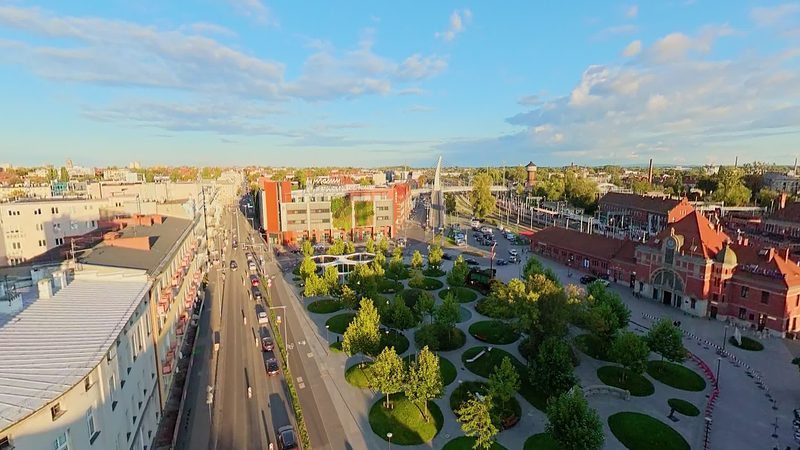
Kora Square and the Main Post Office, Opole — a guided 360° flight
- 5 min
- 360° · 8K
- Open captions
- Online since 23 October 2026
At the first festival, Jerzy Waldorff called Opole the capital of Polish song, and today those words stand on a roof by the station.
About the film
In this film I fly over Olga "Kora" Sipowicz Square, between the Main Post Office, Opole Główne station and the transport hub.
The guide talks, among other things, about the first railway, whose trains from Wrocław stopped in Szczepanowice because there was no bridge over the Oder yet, about the monument to Kora unveiled in June 2026, and about hippies who had their hair cut during the festival and were sent out of Opole by train. One more story from the film: when the festival was run by the Brawo company, several performers, Armia and Ireneusz Dudek among them, refused to take part.
If you arrive in Opole by train, look at the Main Post Office. Its round stair tower once carried a domed frame of insulators, where the town's overhead telephone lines met.
Places in the film
The guide's full text (English)
The first railway here opened towards Breslau, yet its trains stopped short in the suburb of Sczepanowitz, because no bridge yet crossed the Oder. The red-brick front of Dworzec PKP Opole Główne faces the square.
Architect Albrecht, who also designed the town hall tower, built Poczta Główna in 1854 as the first building on the station square, when the post office and station stood far outside the town. Its white facade faces us.
Trains soon ran between Breslau and Oppeln, and once a bridge spanned the river, the line reached the site of today's station, which then lay well outside the town in the middle of open fields.
In 1930 a monument to the postal officials who fell in the First World War went up beside the main post office, and a year later another building was added on today's Korfantego Street.
In 1891 architects from Breslau enlarged Poczta Główna with side wings, an entrance portal and a round stair tower with a dome-like frame of insulators, where the town's overhead telephone lines met. Its white wings face the square.
Maanam's lead singer won national fame with a revolutionary performance of Boskie Buenos and Żądza pieniądza at the Opole festival, and became a leading voice of Polish rock. Plac Olgi Kory Sipowicz spreads out ahead.
When the festival was run by the firm Brawo, known for record piracy and for promoting disco polo, several acts refused to take part, among them the band Armia and Ireneusz Dudek.
In June 2026, on the second day of that year's Opole festival, a monument to the singer Olga Jackowska was unveiled on this square by the main station. Plac Olgi Kory Sipowicz surrounds us.
At the very first festival, Jerzy Waldorff called Opole the capital of Polish song, and his words are still used as the city's motto. The roof sign of the Dworzec Autobusowy repeats them.
On the first anniversary of the singer's death, Paweł Althamer showed a hand-made sculpture in her memory, and at the Opole festival Ania Wyszkoni and Tulia sang the Maanam hit To tylko tango.
Since October 2022 the Związek Polaków w Niemczech, the Union of Poles in Germany, has been the patron of Dworzec PKP Opole Główne. Its first district, founded in Bytom, moved its seat to Opole under Kazimierz Malczewski.
At its first congress, in Berlin's Theater des Volkes, the Union of Poles in Germany adopted the Five Truths of the Poles, the ideological basis of its work, before some five thousand delegates.
During the workers' protests in Radom and Ursus, the authorities even weighed cancelling the festival, and its stars Jan Pietrzak and Olga Lipińska were summoned to warning talks at the communist party committee in Opole.
The Union of Poles in Germany had Stanisław Sierakowski as its first president and Jan Kaczmarek from Westphalia as chief manager, while the leading roles were played by Kaczmarek and Jan Baczewski of East Prussia.
In 1986 the festival's opening was moved to July 22 because of the football World Cup in Mexico, so that Poles would not face the choice between football and music.
Each year the militia made architect Florian Jesionowski sign that the walls and fences would not collapse. When hippies gathered at a festival, those caught had their hair cut and were sent away by train.
Communist censors vetted the festival, cabaret above all: lyrics were first approved by the GUKPPiW office in Warsaw, then local censors sat in on rehearsals, while the secret police ran an operation code-named Amfiteatr.
How the film was made
8K (7680×3840), 60 fps. Open captions in English, burned into the picture: three copies around the view, one next to the place being described. Narration: a synthetic voice in English.
The guide's facts come from:
Back to all filmsFor the cityFilms for deaf and hard-of-hearing viewers
Andrii Shramko
Engineer and filmmaker, living in Bydgoszcz. I have been filming 360° in motion since 2015.