Told from Above · a Shramko 360 series
 Author: Andrii Shramko
Millennium Amphitheatre and Toropol, Opole — a guided 360° flight
- 6 min
- 360° · 8K
- Open captions
- Online since 31 October 2026
Opole's amphitheatre, home to the song festival almost every June since 1963, was designed after a fig leaf fallen to the ground.
About the film
In this film I fly over Opole: from Zaodrze across the Oder, past the Toropol ice rink and the amphitheatre on Pasieka, over the Piast Bridge and by the Piast Tower, to the cathedral and St Alexius' Church.
The guide tells, among other things, about the paternoster lift that survived in the Voivodeship Office, a wooden church that once stood on today's Piłsudski Square, the cathedral organ that got "Spanish trumpets", and what Toropol hosted besides hockey: the Polish figure skating championships and speedway racing on ice. St Alexius' Church holds a historic organ from the monastery in Czarnowąsy.
At the cathedral, look at the old gate: on its sides stand figures of Edmund Bojanowski and Alojzy Liguda.
Places in the film
- Toropol ice rink Map
- Millennium Amphitheatre Map
- Voivodeship Office Map
- Piast Bridge (Most Piastowski) Map
- Piast Tower (Wieża Piastowska) Map
- Opole Cathedral Map
- St Alexius' Church Map
- Zaodrze Map
The guide's full text (English)
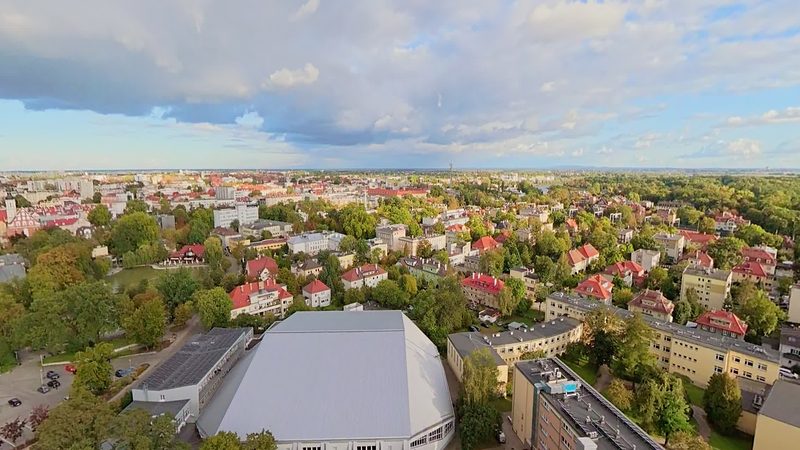
Toropol has hosted far more than hockey matches: the Polish figure skating championships, a Moscow ice revue and the Opolska Gala Żużla na Lodzie, speedway racing on ice, and during the EURO football championship its crowds watched the matches on big screens. White many-sided hall roof across the river.
Why does this amphitheatre look like a leaf? Amfiteatr Tysiąclecia was conceived by the architect Tadeusz Łagiewski as a fig leaf fallen to the ground, and Florian Jesionowski carried out the design. Newcomers who come first in the jury vote of its Debiuty contest take home the prize known as the Karolinka. White canopy among the island's trees.
Toropol, open since 1961, saw the Polish national ice hockey team lose a friendly to Canada on its ice in February 1998. Today Orlik Opole plays its home hockey games here, while figure skaters and short track racers train on the same rink. White many-sided roof of the ice hall.
Amfiteatr Tysiąclecia has hosted the Krajowy Festiwal Piosenki Polskiej nearly every June since 1963. It was later completely rebuilt to a design by the studio Biuro 87a, and today its audience sits under a roof, on 3653 seats, fewer than there were before. Ring of seats under a white canopy.
Wieża Piastowska is one of Poland's oldest defensive buildings, raised under Duke Bolko the First as the keep of the castle of Kazimierz the First, though recent excavations hint it may be younger. Huge and modern for its time because it was brick, it was entered high up from a wooden gallery. Round brick tower under a red cone.
Most Piastowski's white steel arches span the river. Until well into the nineteenth century the west bank of the Oder held nothing but farmsteads and a single church, the Kreuzkirche, a wooden building that stood where Plac Piłsudskiego is now, until it was pulled down early in that century.
In 1840 the Odervorstadt had only fifty-one houses. Towards the end of the century Breslauer Platz, today's Plac Piłsudskiego, was laid out and lined with grand Gründerzeit buildings; some of them were destroyed in the war, and today only a single one survives. Tower blocks and roofs beyond the river.
Opole Cathedral's old gate is flanked by statues of Edmund Bojanowski, who founded a congregation of nuns, and Alojzy Liguda, baptised in this church; parish priest Stefan Balde lies buried nearby. The organ inside, built by Schlag & Söhne and enlarged by Rieger in wartime, later gained Spanish trumpets. Twin brick towers with copper helmets.
Kościół Świętego Aleksego, Bishop Jan Kropidło's foundation, keeps among its treasures a historic organ brought here from the monastery at Czarnowąsy. Its single nave has Baroque furnishings under a ribbed vault, its choir forms an irregular octagon, and a neo-Gothic turret rides the roof ridge. Small church with a many-sided apse.
Szczepanowice has changed its name more than once. In the plebiscite after the First World War the village, then Sczepanowitz, voted to stay in Germany; in the 1930s it was renamed Stefanshöh and became part of the city, with barracks built beside it, and after the war it took the Polish name Szczepanowice. Tower blocks of Zaodrze beyond the river.
Opolski Urząd Wojewódzki was born of a lack of space: the regency had outgrown its offices on Annabergplatz, so under Oberpräsident Alfons Proske a new building took shape. Inside, a modernist staircase of grey marble and a Paternoster lift have survived, while a postmodern lift was later added to the east facade. Long pale block beside a brick tower.
Opole Cathedral rose in rank after the war, when Primate August Hlond made Bolesław Kominek the first apostolic administrator of Opole Silesia and the church became a pro-cathedral. Its towers rise 73 metres, and its steep roof was clad in copper in 1978. Brick nave under a green copper roof.
Kościół Świętego Aleksego burned out completely in 1615 and again in 1739, and only its walls were left standing. Small church below us, red roof.
How the film was made
8K (7680×3840), 60 fps. Open captions in English, burned into the picture: three copies around the view, one next to the place being described. Narration: a synthetic voice in English.
The guide's facts come from:
Back to all filmsFor the cityFilms for deaf and hard-of-hearing viewers
Andrii Shramko
Engineer and filmmaker, living in Bydgoszcz. I have been filming 360° in motion since 2015.