Told from Above · a Shramko 360 series
 Author: Andrii Shramko
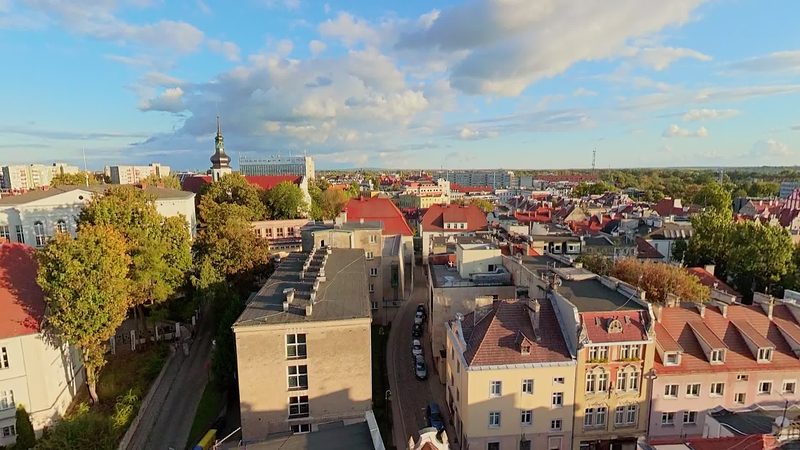
Copernicus Square and University Hill, Opole — a guided 360° flight
- 5 min
- 360° · 8K
- Open captions
- Online since 29 October 2026
Under the Nike monument in Opole there is a room with shelves meant to hold urns with the ashes of Silesian insurgents.
About the film
In this film I fly over Opole: from Copernicus Square and Solaris Center over University Hill with the church "na Górce" and the Museum of Opole Silesia, past the town hall, to the Nike monument and the Opole Philharmonic.
The guide talks, among other things, about the legend of St Adalbert preaching on this hill, the former friary that housed a hospital for more than a century, the Jesuit college that now holds the Jan Cybis collection, and Jan Borowczak's first idea for the monument: a woman on a bison shooting an arrow into the sky. One more story from the film: the church "na Górce" holds a painting of the Immaculate Conception, brought by repatriates from the collegiate church in Stanisławów.
If you are ever in Opole, listen to the bugle call from the town hall tower: it is played every day.
Places in the film
- Copernicus Square Map
- Solaris Center Map
- University Hill Map
- Church "na Górce" (on the Hill) Map
- Museum of Opole Silesia Map
- Town Hall Map
- Nike monument Map
- Opole Philharmonic Map
The guide's full text (English)
The Cytrusek town market once traded on the rectangular southern part of Plac Kopernika, a space that later served for parking, until the parked cars were moved underground and a new square with a fountain was laid out on the surface above them. Old Town roofs, a white tower beyond.
Solaris Center rose on the site of the unfinished Copernicus Center, whose half-built shell had to be torn down at a cost of millions of złoty. The building is among the projects of JSK Architekci, alongside Galeria Drukarnia in Bydgoszcz and the Stadion Narodowy in Warsaw. Red brick, its name on the corner.
Today's Plac Kopernika began as separate squares, Karlsplatz and Wilhelmsplatz, the latter later renamed Platz der S.A., with a brewery building standing between them. Only when the brewery building was pulled down in the 1970s did they merge into a single large square. Grey flat roof below, towers beyond.
The Dominicans' old friary on the hill became a school for nurses and then, for well over a century, a hospital, known until the end of the war as Das Sankt Adalbert Hospital and later named after Karol Miarka. When the hospital moved out, the university took the buildings over and rebuilt them completely. Pale walls among the trees.
According to legend, after Adalbert's death, around the year 1000, a wooden chapel to him and the Virgin Mary rose where the Church on the Hill stands, the town's earliest church building. Its baroque chapel of Our Lady of Częstochowa keeps her image from Brody, in the Lviv diocese. White façade above a broad staircase.
After the Jesuit order was dissolved in 1773, the Prussian administration took over its college here and used it by turns as housing, government offices and a hospital. Today Muzeum Śląska Opolskiego holds 800-plus watercolours and drawings by Jan Cybis, the great Polish colourist born in this region. Red window surrounds, curving walls.
Legend has it that Saint Adalbert preached on this little hill between 984 and 995 and turned the people of Opole to Christianity. Inside the Church on the Hill hangs a painting of the Immaculate Conception, brought by repatriates from the collegiate church in Stanisławów. Onion-domed tower, white façade.
Each day a bugle call, the Hejnał Opola, is played from the tower of Opole Town Hall. Its tower clock once had a dial that counted 24 hours, and a bell, added 1566, that struck every full hour; that bell now rests in the regional museum. White tower with a clock and gallery.
Back in the Middle Ages, Duke Nikolaus I of Opole and his wife, with the Pope's consent, had a friary built for the Bernardine Minorites on a plot beside today's square. That same year a wooden church rose for them, dedicated to Saint Barbara. Green square with a winged stone figure.
Jan Borowczak, the designer of the Nike of Opole, worked on it with the architect Florian Jesionowski and originally imagined a woman shooting an arrow skyward astride a bison. Beneath the monument, unveiled in 1970, 25 years after the war, is a room with shelves meant for urns holding the ashes of Silesian insurgents. Pale stone wings.
The orchestra of Filharmonia Opolska has played some of Europe's finest concert halls, among them the Philips Saal in Rotterdam, the Teatro Municipale in Piacenza, the historic Herkulessaal in Munich and the Golden Hall of the Musikverein in Vienna. Red stone, white portico, glass front.
How the film was made
8K (7680×3840), 60 fps. Open captions in English, burned into the picture: three copies around the view, one next to the place being described. Narration: a synthetic voice in English.
The guide's facts come from:
- Wikipedia (Polish): Pomnik Bojownikom o Polskość Śląska Opolskiego
- Wikipedia (Polish): Plac Mikołaja Kopernika w Opolu
- Wikipedia (Polish): Solaris Center
- Wikipedia (Polish): Kościół Matki Boskiej Bolesnej i św. Wojciecha w Opolu
- Wikipedia (Polish): Muzeum Śląska Opolskiego w Opolu
- Wikipedia (Polish): Uniwersytet Opolski
Back to all filmsFor the cityFilms for deaf and hard-of-hearing viewers
Andrii Shramko
Engineer and filmmaker, living in Bydgoszcz. I have been filming 360° in motion since 2015.