Серія «Told from Above»
 Автор: Андрій Шрамко
Острів Пасіка і Острувек, Ополе — політ 360° з гідом
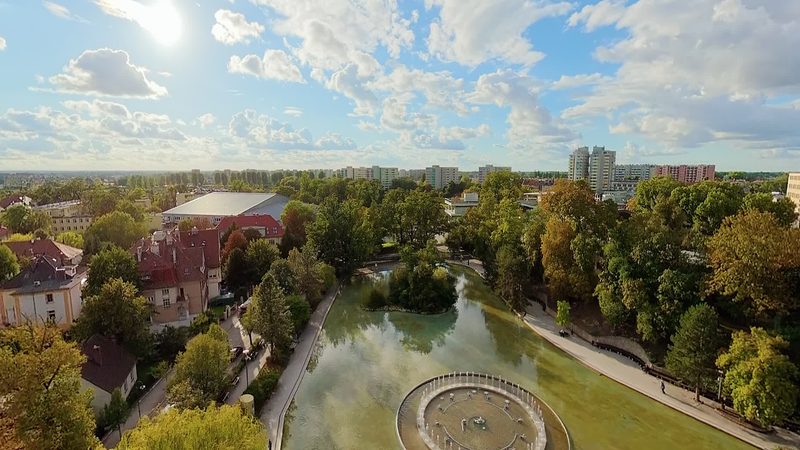
- 6 хв
- 360° · 8K
- Субтитри на екрані
- Онлайн з 19 жовтня 2026 р.
На цьому ставку чотирнадцятирічна дівчина стала чемпіонкою Німеччини з фігурного катання.
Про фільм
Це була Максі Гербер, згодом олімпійська чемпіонка. У цьому фільмі я пролітаю над Пасікою — островом між Одрою і Млинувкою, — над Грошовим мостом і П'ястівською вежею.
Гід розповідає, зокрема, як протести поляків урятували П'ястівську вежу, коли з 1928 року розбирали замок на Острувку, і звідки Грошовий міст має свою назву. Ще одна історія з фільму: 1897 року новий рабин Ополя Лео Бек відчинив двері синагоги на острові, а 1997 року повінь на Одрі затопила всю Пасіку.
Якщо приїдете до Ополя, зазирніть до Амфітеатру Тисячоліття: сцену пісенного фестивалю закінчили за день до відкриття.
Місця у фільмі
- Острів Пасіка (Wyspa Pasieka) Мапа
- Острувек (Ostrówek) Мапа
- Млинувка (Młynówka) Мапа
- Грошовий міст (Most Groszowy) Мапа
- Крижаний будиночок (Domek Lodowy) Мапа
- П'ястівська вежа (Wieża Piastowska) Мапа
- Амфітеатр Тисячоліття Мапа
Повний текст гіда (англійською)
The Młynówka below us looks like a canal, but it is an old bed of the Odra. It carried the river's main stream until a great flood, and city plans then called it the Oder Fluss.
The Młynówka once worked as a transshipment port, until a new river port at Zakrzów took over that role. A lock was built on it, and city plans marked it as the Winter Hafen, the winter harbour.
Regency president von Pückler founded a society to beautify Opole, and councillor Ludwig Sack ran it with energy. They began by laying out a park on Pasieka, and later the island became a place for villas.
Crossing here once cost a grosz, and that toll gave Most Groszowy its name. The year 1894 brought a footbridge for walkers here, and the year 1903 the double-span bridge itself. A green footbridge crosses the water.
A rake, a crossed scythe and a spade marked the seal of Wilhelmsthal, the colony on Pasieka named after Wilhelm Krause, a regency building councillor, which later became part of Opole.
Old Ostrowek in the north, with the castle, and the colony of Wilhelmstal once shared this island. They merged into a single commune, and by the early twentieth century the island had grown into a villa quarter.
Franz Idzikowski already argued that the name Ostrówek comes from Old Polish for a little island, an islet in a river. The district lies between the wider Odra to the west and the narrower Młynówka to the east.
Rabbi Adolf Wiener and the wealthy pharmacist Ernst Muhr championed a new synagogue for Opole's Jewish community. The idea was well received, and it became the largest in the town, on what was then Hafenstrasse.
In June 1897 the new rabbi of Opole, Leo Baeck, opened the doors of the synagogue with the words: Behold, I open you, O consecrated gate, for the pious faithful.
After the war a nursery rose where the synagogue stood. In 1998 a stone was set there for the synagogue burned in 1938, with a plaque in Polish, German and Hebrew: people will not forget.
In July 1997 the Oder's flood of the century covered this whole island, and in its streets the water stood several metres high. A pond lies below us.
Domek Lodowy, the Ice House, saw a fourteen-year-old become German champion: the skater Maxi Herber won the German figure skating title here, and later became an Olympic champion. The red-roofed chalet stands by the pond.
Ships still moored on the Oder at the island's northern tip into the twentieth century, north of us, and the street there was called Hafenstraße, Harbour Street, until the end of the war.
Mayor Musioł and Jerzy Grygolunas of Polish Radio started the song festival at Amfiteatr Tysiąclecia. The stage was finished the day before the opening; Musioł checked the works at five every morning. A silver shell roofs the stage.
Polish protests saved Wieża Piastowska: when regency president Alfons Proske had the castle pulled down from 1928, the Polish minority and the Union of Poles in Germany stopped the tower's demolition. The round brick tower stands beside us.
Retreating German troops blew up the old bridge in early 1945, and its successor, Most Piastowski, finished in the year 1963, stands on the foundations of its pier. The white double-arched bridge crosses the Odra.
The town kept a store of iron and copper here on Ostrówek, charging for its use, and through it the road from the west entered by the Oder Gate, also called the Wrocław Gate.
Bishop Jan Kropidło paid for Kościół Świętego Aleksego, built after the year 1421 together with the hospital next to it. Its slim gilded spire rises over the roofs.
Як створено фільм
8K (7680×3840), 60 кадрів/с. Відкриті субтитри англійською — три копії довкола, одна біля місця, про яке розповідає гід. Озвучення: синтезований голос (англійською).
Факти гіда — з джерел:
Усі фільми про містоДля міської владиФільми із субтитрами для глухих і людей зі зниженим слухом
Андрій Шрамко
Інженер і кінематографіст, живу в Бидгощі. 360° у русі знімаю з 2015 року.