Серія «Told from Above»
 Автор: Андрій Шрамко
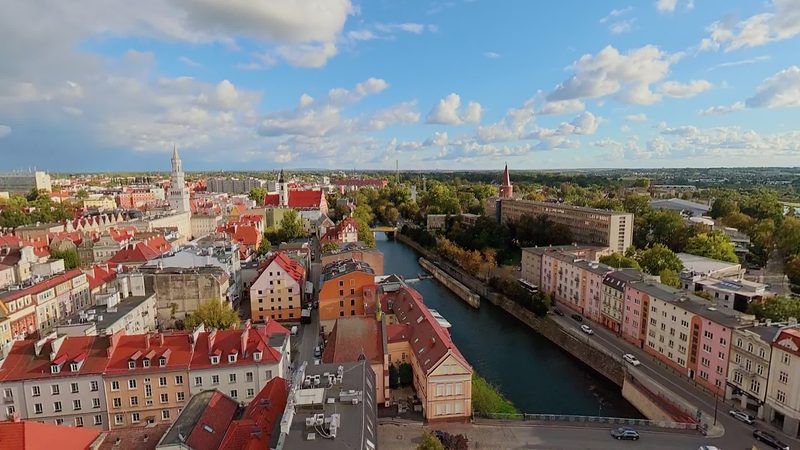
Собор і П'ястівський міст, Ополе — політ 360° з гідом
- 10 хв
- 360° · 8K
- Субтитри на екрані
- Онлайн з 27 жовтня 2026 р.
Замку П'ястів на опольській Пасіці вже немає, а його вцілілу вежу мешканці давнього Оппельна прозивали «Proskespargel», тобто спаржею.
Про фільм
У цьому фільмі я пролітаю над опольським Старим містом: від собору Святого Хреста через Млинувку і Жовтий місток до ратуші, костелу Святої Трійці і фонтана на площі Свободи.
Гід розповідає, зокрема, про Ізабелу Ягеллонку, яка хотіла оселитися в замку, але той уже не годився для життя, про селянського бунтаря Марека з Ємельниці, якого відшмагали біля ганебного стовпа на Ринку, і про підвал під ратушею, де наливали пиво зі Свидниці. Ще одна історія з фільму: Флоріан Єсьоновський, автор фонтана-метелика на площі Свободи, спроєктував і навіс стоянки таксі на сусідній вулиці Міноритів.
Якщо приїдете до Ополя, зазирніть до костелу Святої Трійці: у крипті під головним вівтарем спочиває Ельжбета Свидницька, онука Владислава Локетка, поруч з опольськими князями і княгинями.
Місця у фільмі
- Собор Воздвиження Святого Хреста Мапа
- П'ястівський міст (Most Piastowski) Мапа
- П'ястівська вежа (Wieża Piastowska) Мапа
- Замковий міст (Жовтий місток) Мапа
- Ратуша Мапа
- Костел Святої Трійці Мапа
- Опольська філармонія Мапа
- Площа Свободи (plac Wolności) Мапа
Повний текст гіда (англійською)
By tradition, Bishop Klemens of Wrocław gave Holy Cross Cathedral a relic of the Holy Cross in 1024, and half a cross was then added to the eagle on Opole's coat of arms. The cathedral is red brick with twin spires.
In 1933 a rebuild gave Most Piastowski's forerunner, the Jahrhundertbrücke, a steel structure in place of its many old spans, as another bridge nearby opened. The Piast Bridge is the white steel arch over the Odra.
Architect Józef Cimbollek gave Holy Cross Cathedral its west front and raised its towers higher, in work that began in 1899, during a larger renovation of the cathedral. Look for its twin red spires.
On Daniel Petzold's plan of Ostrówek, the rest of Pasieka island stood apart as its own administrative and economic unit, with the town's warehouse, smallholders' cottages and a boundary line between town land and the Piast Castle's grounds.
In 1812 Kościół Świętego Aleksego got its altar painting, the Death of Saint Alexius, from the Franciscan church; its Pietà is far older, dated 1505. Look for its green turret.
When floods threaten, new locks can now shut the Młynówka off from the Odra completely: there is a lock by the Cathedral Bridge, and another at the southern tip of Pasieka island.
Opole's Piast Castle was begun under Duke Kasimir, probably the earliest duke to live in Oppeln, who invited settlers, hospites, from the West and granted them rights under German and Flemish law.
Polish troops of King Władysław Jagiełło besieged the Piast Castle and left it damaged, yet the Piasts of Opole kept it as their seat until the last of their line, Jan Dobry, died.
Izabela Jagiellonka, sister of King Zygmunt August, received the duchy of Opole and Racibórz as a pledge and planned to live in the Piast Castle, but by then it was not fit to live in.
Later the governor Jan von Oppersdorff had the Piast Castle partly rebuilt in Renaissance style, and the work was overseen by Francesco Parr, an Italian mason known from the castles of Brzeg and Oleśnica.
Opolski Urząd Wojewódzki partly stands on stilts: its middle section rests on slender pillars modelled on Le Corbusier's pilotis, so the street can look straight through to the former park behind. The long office block, beside the tower.
Local legend says King Jan Kazimierz Waza hid in the Piast Castle from the Swedish invasion, but it was already half in ruins, and the king stayed in a town house called Pod Lwem, Under the Lion, before moving on.
After a war over Silesia, the Piast Castle passed to Prussia along with the hereditary duchy, and later its rooms housed the Regierungsbezirk Oppeln, the seat of Prussia's regional government.
The architect Paul Kieschke later added a whole new wing in neo-Renaissance style, and by then the Schlosspark, the castle's park, had already been opened to the people of Oppeln.
Since the Middle Ages a wooden bridge crossed the Młynówka here; Most Zamkowy, known in town as Żółty Mostek, the little yellow bridge, took its place and was rebuilt after the war.
In everyday Oppeln speech the Piast Tower went by a nickname: Proskespargel, the asparagus. It stands on the Oder island south of the Old Town. It is the round brick tower.
Opolski Urząd Wojewódzki began with a closed competition, won by Konrad Lehmann, a government architect from Schneidemühl. His building follows the Młynówka and takes in the old tower spared from demolition. It is the long office block.
From 1931 to 1939 Poland kept its own consulate on Pasieka island, in a building that still stands among the island's many offices and libraries; today Germany has its consulate here.
The Piast Tower's roofs kept changing, but its walls held. A fire in 1739 burned its first cone-shaped roof; the pointed spire it wears today carries a Piast eagle made by Marian Nowak.
Most Zamkowy has been a listed monument since 2016; in early 2025 its full renovation began, with its metal parts dismantled for conservation, and the bridge is to keep its yellow colour. Its yellow railings span the Młynówka.
Duke Jan Dobry, Jan the Good, threw the Franciscans out of Holy Trinity in 1516 and brought in the Bernardines; the Franciscans came back only later. Kościół Świętej Trójcy is the brick church with the white tower.
In a long war the Piast Castle was fortified, and imperial troops besieged it in vain in 1633 and again in 1634, yet by the end of the war it was recorded as badly damaged.
In 1794 the peasant rebel Marek from Jemielnica was flogged at the pillory on the market square around Ratusz, then driven out of town. The town hall has the white clock tower.
In the Piast Castle's south-east corner stood a free-standing round keep of last defence, close to the gatehouse; archaeologists dug up what was left of that gatehouse in 2011 and 2012.
Ratusz once had the Fürstensaal, a princes' hall under Gothic vaults, and beneath it the Schweidnitzer Keller, pouring beer brought from Schweidnitz, today Świdnica. The town hall wears the white clock tower.
Since 1969 the orchestra of Filharmonia Opolska has carried the name of Józef Elsner, a composer bound up with the Opole land for good. Its hall is dark glass and brick.
Only the Gothic foundations outlived the demolition, so little is known for sure about the Piast Castle's later look; between 1948 and 1951, digs on Pasieka found the foundations of a free-standing Baroque castle chapel.
A taxi stand shelter on nearby Minorytów Street, next to the Franciscan monastery, is the work of Florian Jesionowski, who also made Fontanna na Placu Wolności. It is the round fountain with the colourful sculpture.
In 2004 the orchestra of Filharmonia Opolska represented Poland in Brussels at the celebration of the European Union's enlargement, and played in Salzburg to mark the anniversary of the attacks on the World Trade Center.
Florian Jesionowski, a Polish architect and artist, made Fontanna na Placu Wolności in 1957 and shaped it as an abstract image of a dancing butterfly. Its basin is round, with the bright sculpture.
Beneath Holy Trinity's high altar lies a crypt, and in it rests Elżbieta of Świdnica, granddaughter of King Władysław Łokietek, beside dukes and duchesses of Opole. Above them rises the white tower.
Як створено фільм
8K (7680×3840), 60 кадрів/с. Відкриті субтитри англійською — три копії довкола, одна біля місця, про яке розповідає гід. Озвучення: синтезований голос (англійською).
Факти гіда — з джерел:
- Вікіпедія (польською): Wieża Piastowska w Opolu
- Вікіпедія (польською): Zamek Piastowski w Opolu
- Вікіпедія (польською): Katedra Podwyższenia Krzyża Świętego w Opolu
- Вікіпедія (польською): Most Piastowski w Opolu
- Вікіпедія (польською): Most Zamkowy w Opolu
- Вікіпедія (польською): Ratusz w Opolu
- Вікіпедія (польською): Kościół Świętej Trójcy w Opolu
- Вікіпедія (польською): Plac Wolności w Opolu
Усі фільми про містоДля міської владиФільми із субтитрами для глухих і людей зі зниженим слухом
Андрій Шрамко
Інженер і кінематографіст, живу в Бидгощі. 360° у русі знімаю з 2015 року.